
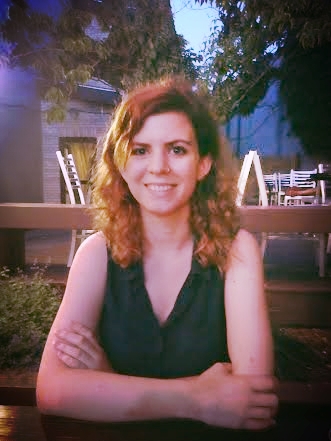
Alex Olivier is a Boston-based electronics tinkerer, installation artist, and an explorer of physical things that can be made to swirl, float, light up, and generally be interactive. Her work has been featured in various shows, exhibits, and international conferences. I had the pleasure of sharing a lemon pie bar with Alex at Union Square's Bloc 11 where she told me about her passion for the playful intersection between art and engineering.
 How did you get into this field?
All through high school I really wanted to be a virologist, and work for the CDC (Center for Disease Control), and I used to read all these really dorky books. So when I got to Wellesley I was very set on majoring in biochemistry. My first semester I took chemistry and it was a good class, but there was something missing... I always wanted to have more of a hands-on approach. At some point I got this stipend to do research with a faculty member. We were encouraged to choose a professor to work with and I found this guy named Robbie Berg. He did a lot of very scientific things, like laser cooling of atoms. He also did less scientific things, like build robots that were made out of felt and perform a puppet show. So I was like, "OK, I will talk to this guy and see what he has to say."
I went to some science center informational event and I asked him, "What about this class, The Art of Electronics?" And he freaked out. He was like, "Let me show you my electronics lab right now." He took me in there and showed me every little invention that was in the room...and it was amazing. I had never seen anything like it: bike wheels spelling out messages when you spun them, and all different kinds of robots and games made by students. And I was like, "I have to work with this man." From that point on I got really into electronics and programming, especially programming physical things - you know, that combination of doing circuitry and programming.
Tell me more about your acedmic projects.
The next three years I took all the required computer science classes with exams and whatever, but the classes that I really liked and did well in were very open-ended and very project-focused. One project, for example, was a DJ costume that could control music with bubbles and lit up, and did all these crazy things. We used conductive thread to connect all of the electronics... We had to sew all of the LEDs and it was wireless. Everything I did had some electronic component to it.
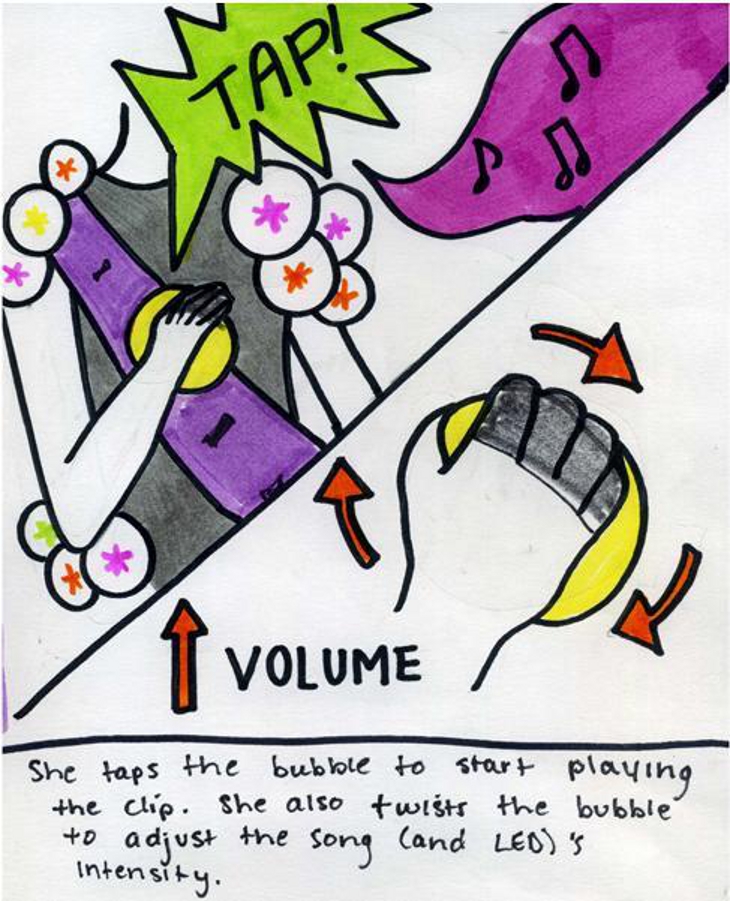
Photo credit: Alex Olivier
For my senior thesis project I did this electronic toolkit to do interactive wireless insulations, or creations, inventions, whatever you want to do. And that was a really big project for me. Basically, you have all of these little boards and you can plug in different sensors or actuators, but they can all talk to each other. It was all programmed in LOGO, an educational programming language. You could change things in real time and say, "Oh if this light sensor over here is dark, turn on this motor over here and make a flower open."
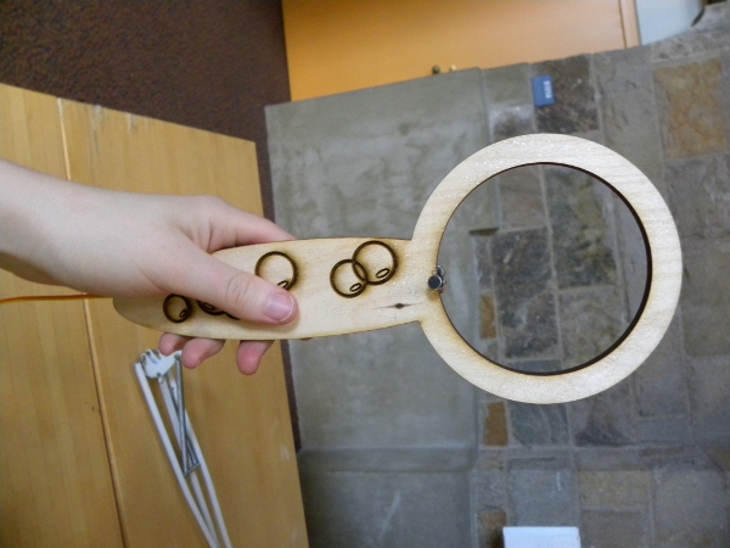
Photo credit: Alex Olivier
So I started making all these wireless installations and then I ended up getting a fellowship to do a project with them. I got to do this - looking back, it's horribly embarrassing and hacked together -- but I did this wireless installation at the Wellesley Science Center that was called Social Synapses. It was all of these neuron sculptures with LEDs and they responded to motion sensors. Wellesley has this atrium - it is five storeys and it's like an open space and it has these crossing catwalks - so the sculptures are hanging from the different catwalks. And the sensors are at the bottom. But it was the biggest project I had ever done. I designed all the circuit boards and I made them, got them fabricated, put all the parts on, wrote the protocol to do all the wireless communication, and then the sculptures themselves - I mean, I soldered 2,000 LEDs. I was just going crazy.
Was all of this part of your thesis?
Technically, no but it was using my thesis. I remember presenting my thesis at some senior thing and some chemistry major was like, "How is this useful?" And I thought, "Wow, I could have been that chemistry major." I mean, it is useful. I have a lot of defenses prepared at this point. The original intention was to make a toolkit so that other people could easily make things.
So I did all of that and then I went to grad school. There is a program at NYU called The Interactive Telecommunications Program, which is basically like kindergarten for adults with focus on art and technology. I took a lot of good classes. I took biohacking which was fun. I liked the Puppets class a lot - it was all puppets, all the time. We did a different style puppet every week.
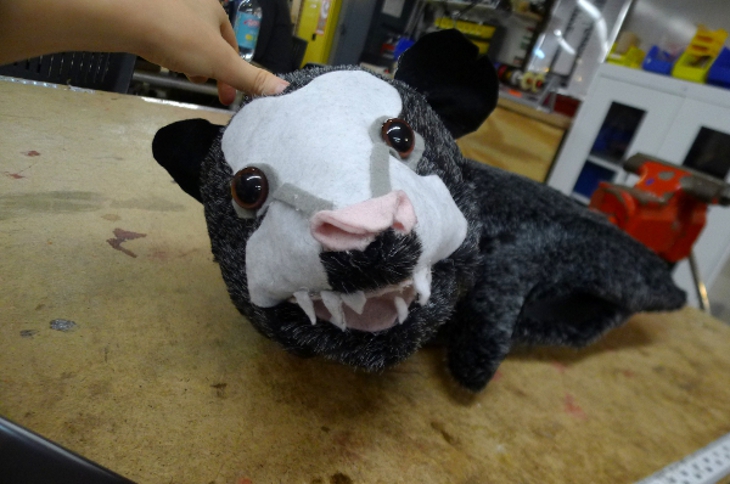
Photo credit: Alex Olivier
What was your favorite project?
I did a pop-up window display as part of a class, which was fun. We got to do whatever we wanted in this abandoned window, so we made these jellyfish that floated using motors and lights. The building was owned by NYU but hadn't been used in a couple of years. It was a great group project experience.
How did your interest in science first emerge?
I was always really interested in animals. My entire family loves animals. Maybe that was the first step because I would read about animals, memorize facts about animals, just want to know every single thing about animals...and then when I got into high school I just wanted to learn about smaller animals. I guess that's where the interest in virology came in.
How did you get good at this stuff?
If you can let go of the idea of innate intelligence about subjects - I mean, so much of it is practice and just learning how to solve certain problems. I definitely wasn't the best computer scientist when I started out because I had no experience. But you can become good at almost anything.
 If you can let go of the idea of innate intelligence about subjects - I mean, so much of it is practice and just learning how to solve certain problems.
In the grad school program I went to there were people who didn't know how to do high school algebra and by the end of the two years they were able to build stuff and be confident, and figure out any kind of way of accomplishing their goal. The thing is you have to be scrappy, you know?
Yep, totally. So what do you do now?
I work at a place called Sosolimited, which is an art and technology studio in Boston. We work on lots of projects - we do interactive installations, physical objects that are somehow controlled by data and are dynamic in some way. A lot of Soso's earlier work used sentiment analysis on text to do different things. They did some pieces where during the Presidential debates they would dissect the speech of the debates and you could see which of the debaters was speaking more like a truth-teller, which of the debaters was speaking more like a liar. So we do a range of stuff but it is definitely in line with the kinds of things that I was interested in doing.
It seems like you are more drawn to physical installations rather than digital work?
I definitely like physical things. But after working at Soso, I've come to appreciate more software-driven tricks. Basically, how in software to better control physical things - more sophisticated ways of controlling lights and things like that.
The intersection of hardware & software is super hot right now. What do you think about that?
People love hardware for different reasons. Smart houses are definitely a huge thing, the quantified self, tracking yourself... My love of hardware comes more from a place of play and being able to explore, and build different things. I am kind of old-fashioned. I am not a web programmer - I don't know too much about all the different web platforms. But hardware isn't that complicated and you can make it do so many things once you understand the underlying principles. I like that simplicity.
My love of hardware comes more from a place of play and being able to explore and build different things.
What do you want to do next?
I am doing cool things at work, but trying to find the time to do personal projects as well. I am trying to figure out how to do my own projects. I am not great at getting them out into the world. I am trying to move away from my previous hacker aesthetic and make objects that are more polished and have more of a conceptual underpinning.
Who pushes you?
My boyfriend, Andrew. He is also an electronics enthusiast, mostly doing drones and robots. Even though we don't make the same things, we definitely feed off of each other in terms of growing our enthusiasm for our different projects.
And you know, people at work. We have started to talk about our personal projects and I think if you have that community of people who make art every single day, you need to talk to them about it.
What is a problem worth tackling?
Something that I am really passionate about is electronics education and I know it's like beating a dead horse, but I am not just going to say women here. It's not just women - it's people from different demographic groups.
There is a great place in the South End in Boston called the South End Technology Center - they have a fab lab there. And students there can build, use laser cutters, and do whatever they want to do. But I feel like there need to be more paths for students to find their way into a technology job. It shouldn't just be make perfect grades in high school, then go to a great college, and then get a job. Because a lot of these skills you can learn by tinkering and exploring in your own way. It's a two-way street - helping young people find their own path to these kinds of subjects and it's also helping people at companies recognize the legitimacy of these other paths.
What would be your entrance music?
It will have to be a very empowering song. I am going to go with "Gut Feeling" by Devo.
What if tomorrow you can no longer do electronic installations? What else would you do? This question I stole from Jon Walley.
Oh, easy. I will take care of animals in some way. I have pet mice right now, so I like all kinds of animals. I will either be a veterinarian or work at some kind of a rescue organization, or even do field work - like document animals.
What advice would you give to your younger self?
Play more. Explore more. Don't stick to your five-year plan. Even if you feel stupid, keep going - you will learn it eventually. I still have to tell myself all of these things.