
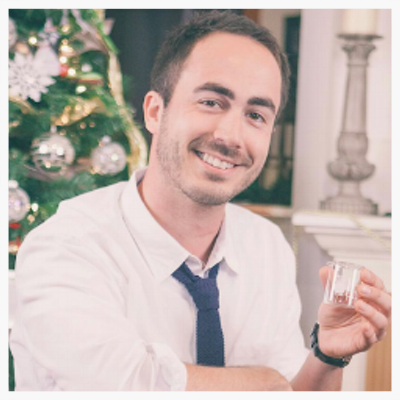
To understand Edward Miracco you have to first get a grasp on the work he's been doing for the last five years in telomerase research.
Here's the woefully simplified version. The cells in our body divide throughout our lives, but not endlessly. There's a timer called a "telomere" that's running and sets how many times they can divide.
As Edward explains it on his research funding site, "You can think of it like the little plastic tip that seals the end of your shoelace. This little tip, known as an aglet, prevents the shoelace from fraying; a telomere is the DNA "tip" that prevents a chromosome from fraying." Once the telomere runs out, the cell is unable to divide anymore and "retires." Now, here's where the study of teleomeres intersects with cancer. Whereas most cells have a limit to the number of times they divide and replicate, cancer cells have a little machine—an enzyme called telomerase—that elongates the telomere (timer). So they can divide forever and take over. Stop the telomerase and you could stop the slow spread of cancer.
It was Edward Miracco and his colleagues who solved the first complete structure of this lynchpin. And knowing what your enemy looks like is the first step to designing drugs that inhibit it.
He and I met up at Lord Hobo in East Cambridge to talk cancer research, music and the ever-calling allure of being first.
So Telomerase could be a route to slowing cancer cells, what else draws you to this work?
My friend, he is very obsessed with living forever. I'm glad he exists because he's going to be the guinea pig for all of these drugs out there. So one thing that he's been taking recently is called TA65 and it looks very similar to cholesterol. It has been shown in different studies to increase the gene expression of the active subunit of telomerase. People think if you can do that in a controlled fashion you can elongate your telomeres which could increase longevity. So he's been taking it for over a year and he gets his telomeres measured and [dramatic pause] he hasn't seen much of a difference. Surprise, surprise. But that doesn't mean that there's not a future for it. He's clearly taking a pill and these structures are very complicated and delicate. In biochemistry, all that matters is the structure of the molecule. What's a good metaphor?… It's like a three dimensional key that's fuzzy and vibrates all the time. When it shakes and vibrates in a certain way, it'll fit in perfectly. You just have to find the right fit.
You use metaphors a lot. Is that just a communication technique or does it also define your internal thought process?
So you're wondering if I internally think in metaphor to help me understand what's actually happening? You know it starts out like that and then it becomes actually visualizing and seeing it in my head. So someone would say, "Oh a telomere, its ends fray. How do we prevent that?" So inside my head I imagine an image of a chromosome with a plastic cap on the end. And then the cap gets smaller and smaller and then it frays. So yeah it's a little of both.
It definitely has to be slightly metaphorical because we don't really know exactly what it looks like. We have an idea. We can draw out lines and sticks and letters to show carbon-carbon-bonds, but that's really a way for us to try to describe metaphorically what's actually happening. But there is a cool thing that came out a couple years ago for the first time. So benzene is six carbons in a ring, all connected to each other. It's a flat model. And these scientists [IBM] were able to stabilize this benzene ring and take an atomic force microscope and very carefully go over the whole thing and actually see the atoms and molecules.
Did you see that picture? I gotta show it to you. It's wild. [Pulls out his phone]
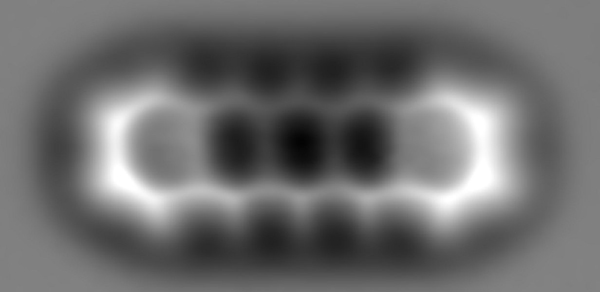
It's like the first time you go: "Oh! All this they were teaching us in chemistry in high school actually has some basis in reality."
It was a wild day when I saw that.
Why is that so cool to you?
I get a kick out of being the first person ever to know things. I guess you could say its like being a scientific hipster in some sense. For example, doing the telomerase project. When we solved that first telomerase structure, I thought, "we're the first people in human history to have ever seen this." And that to me... I don’t know, I like being first.
Seeing something for the first time and pushing the limits of technology, it's always been my raison d'état.
My existence is to do things first. Not to compare myself to Magellan or Columbus, but there's that innate human drive to explore.
 I get a kick out of being the first person ever to know things. I guess you could say its like being a scientific hipster in some sense. When we solved that first [telomerase] structure, I thought: We're the first people in human history to have ever seen this.
Do you remember the first time you felt that?
There have been a few aha moments in my life. So many of them have come recently. In my PhD I worked on enzymes. Are you familiar with what an enzyme is? It's a protein that does chemistry. The enzyme I worked on converts one nucleotide, which are the building blocks of DNA and also the building blocks of RNA. So this enzyme converts one nucleotide of RNAs into something new. We were analyzing it and couldn't figure out what it was being turned into.
So we were looking at it and it just didn't make sense. Lo and behold, it was something new that people had never seen. There was a paper a few years prior that had described this product incorrectly. And then in their paper they said, "Data not shown" - which is a common phrase in scientific papers when they don't know what the fuck is going on and it's data that's contrary to their conclusions. So they'll just omit it from their papers. It's a little unethical.
But this one moment, it changed the project completely. I applied for postdocs before this point. Just being like, "This is all I've done. I've gotten to this point, I hope in the next year I'll have an answer, but can I have a job with you anyway?” It was hard to convince people that I was going to succeed. I remember the moment that it hit me. The moment I succeeded, I ran into my boss's office and I was like, "IT'S THIS. It's THIS product. THIS is what's being formed."
My PhD advisor was very cut and dry. If you gave him something that looked like bullshit he was quick to say, "Get out, this isn't right." So I remember getting in there and he was like: "Wait a second." He takes a second, leans back, strokes his chin a little and says: "Okay." And then all of the pieces of the whole five-year project fit together. At that moment I was like, "We did it."
Really, I appreciate Professor Feigon for picking me up before actually solving this problem.
Does that happen a lot, where it's one piece that's missing and once you figure out that component everything else falls into place?
Happens all the time. The part that drives me the most wild is that usually there's that one piece and that shows you that there were five other pieces at the same time. That's why you couldn't figure it out. There's always a million things going wrong, but there's that one piece that opens the door to let you see all of the other things going on.
So what are you doing now?
I work in process science now [at Moderna].
What's process science?
That was my question when I was applying. [laughs].
It sounds like a lot of TPS reports to me.
It's surprisingly few. At Moderna, we make a product, mRNA. My job is to troubleshoot the making of the mRNA. It's been an amazing job. I am so glad about my decision to go into industry. In academia, you have all the time in the world but no money; in industry you have all the money in the world and no time. That's it. And that changes the way you do science. In academia, I would spend days on Reddit doing nothing because I'm thinking about a problem. Here it's like, if I don't have the problem solved in 20 minutes to an hour, it's time to move on. If it doesn't stop the company dead in its tracks, that's not a problem that needs to be solved right now. It fits my personality so well.
It strikes me that you would be very good in academia though. You have a nice way of explaining things.
I love teaching. I love it. But I get to do that here with co-ops. For the first time in my life I'm using all of my skills and growing as a scientist. It's really fantastic. When I was a post-doc I would jump out of bed and get to work by 9:30am. Now I jump out of bed and get to work by 7:30am, because I'm that excited about it. What we do is so groundbreaking and so new, it stands a chance of turning the whole bio-pharmaceutical industry on its head.
It was always this company. I wouldn't have left academia for any other company.
What they [other companies] work on isn't a 10th as exciting as what we work on at Moderna.
Is that because of the scale of impact?
We are directly trying to make something new. My telomerase research was all so that hopefully we can design a drug somewhere down the road. Now we're actually creating the drug.
In the thick of it, how much of you is focused on the micro-milestones and how much of you is thinking about the larger narrative?
I've been very fortunate in that the people I work with recognize my strengths and weaknesses and my strengths lie in the big picture. Solving the big problems. Not in the upkeep of the current situation. My job in the past has kind of evolved into tackling big problems. In graduate school, I learned every technique that I possibly could. [Describes three or four]. I spent years learning purification techniques. I came here and this company needs all of these techniques. So everything I've been working on in my entire life -- all of the techniques I've learned and everything I'm good at, I get to do. I'm in heaven. It's amazing. And that scares me sometimes.
Why does that scare you?
I'm not superstitious but when things go really well for me I feel like it's gonna revert back somehow. Like I feel like the universe is ultimately a big balance and if you go too far one way, something’s going to bring it back.
How do you simplify difficult scientific concepts?
There's been this big project I've been working on for the last month. I've had to break every single part of it down with the help of my colleagues.
Are you looking for abnormalities?
We're looking for causal relationships. We have a problem. We're looking to find the root of that problem, and so I've been working very closely with one of my colleagues who thinks like I do. He and I together, I think, have gotten a handle on it.
Do you like working with a partner?
That's something I've learned about myself is that I'm bad working on my own. I need a partner. If you do things by yourself, there's no one there who's equal to you to tell you to shut the fuck up. There's always these stories of people surrounding themselves with yes-men. I never understood that concept, because to me it's like, if something's wrong I'm going to say it's wrong. So with that being said, I've surrounded myself in this project with people who will help me figure it out.
Does your approach to science spill out in other ways?
Scientifically you tackle a problem by doing an experiment, finding results, seeing if the results logically fit your hypothesis and if not, changing things. In relationships between humans, the facts are...gray. In a casual conversation if a person misrepresents a fact, who cares? There are times in conversation when I will be inappropriately blunt and not take into consideration the nuances of human interactions and feelings. My fiancée is fantastic at helping me see that it doesn't matter if it's right or wrong, don't be an asshole. In cultivating a relationship with another person, it's not scientific. If you try to make it scientific - you're gonna have a bad time.
Who pushes you the hardest?
I am a strong evolutionist in the sense that I believe that humans exist for a sole purpose - reproduction. Logically when I look at things, art, advancements in engineering, happiness, these are all things that are wonderful, but ultimately it's to get laid.
That being said, who or what pushes me the hardest? I push myself the hardest and I push myself the hardest for the sake of my children, and I don't even have kids, but I hope to have kids. The way I see it: if I bust my ass and make the best possible local situation or global situation, then that's what I'm supposed to do. I don't see how there is any other answer. And that might be me being a scientist, but scientifically I am pushed by wanting to create the best possible situation for my progeny.
I would hope that what I make better for my progeny makes all of the progenies better because ultimately if it's only my progeny succeeding that's a failure. You need everyone's progenies to succeed to have that gene mix to succeed as a species. Really what we want to do is get off this planet and to do that we need generations.
What do you mean when you say "get off this planet?"
I mean, If we keep growing the way we're growing we're going to saturate the caring capacity of the planet. It's very simple.
What enthralls you outside of science? What kind of music do you listen to?
In terms of music I love improvisational music. Anything improvisational. When I was younger I would follow Phish around a bit. Dark Star Orchestra is a cover-band for the Grateful Dead. They're fantastic. I definitely enjoy listening to lots of jazz, live music. I'm a disciple of Sidney Bechet and a lot of the older saxophonists. Dizzy Gillespie is fantastic.
Anything where you can listen to someone play and it's an exact representation of their consciousness in music form with no delay. That's a pure way of connecting with someone's state of mind. This is all bullshit, likely, but this is the way I like to think about it. At the end of the day we are a collection of biochemical reactions. Those biochemical reactions lead to changes in polarization states in your brain so the nerves are firing and there are currents and frequencies and all kinds of electrical signals going on. When you hear a frequency like in a guitar or something, you're stimulating something in your brain, and who knows, maybe what that person was thinking came out into their guitar and in a sense you're mimicking the brain waves they had when they did that. And that's different than a rehearsed piece of music.
Jazz piano is my favorite by far. I've been to jazz piano shows where I've literally been brought to tears because of the music. It just blows my mind. But I can't play music worth shit.
At the end of the day we are a collection of biochemical reactions... When you hear a frequency like in a guitar or something, you're stimulating something in your brain, and who knows, maybe what that person was thinking came out into their guitar and in a sense you're mimicking the brain waves they had when they did that.
That goes back to your earlier comment about wanting to be first, being there for the first time they ever hit that note.
That moment has never existed before. I think that's my fascination with time too because everything is new. Every moment is new. Sometimes I'll walk around and look around and be like, this has never happened before. It's a fun experience. It's how I live my life I guess...
But then I get hung up on stupid shit too, so it's not all sunshine and roses.