
 What is nanotechnology?
So your hair is about 100 microns thick.
There's a meter, then there's a millimeter, then there's a micrometer. As you know, a millimeter is one-thousandth of a meter. A micron is one-thousandth of a millimeter. So your hair is 100 of those. Now a nanometer is a hundred thousand times smaller than that. Basically, it's the relationship between a meter and a strand of your hair, but even less.
How are you a kid, growing up in Quincy, deciding that you want to study infinitesimal things?
That's a loaded question. It all really starts with energy. I've always been interested in renewable energy. One of my projects is working on thermoelectrics, which is a matrial that directly converts heat into electricity. Energy flow at the nano scale is really where all of the new ideas are coming out.
How does heat transfer relate to nanotechnology?
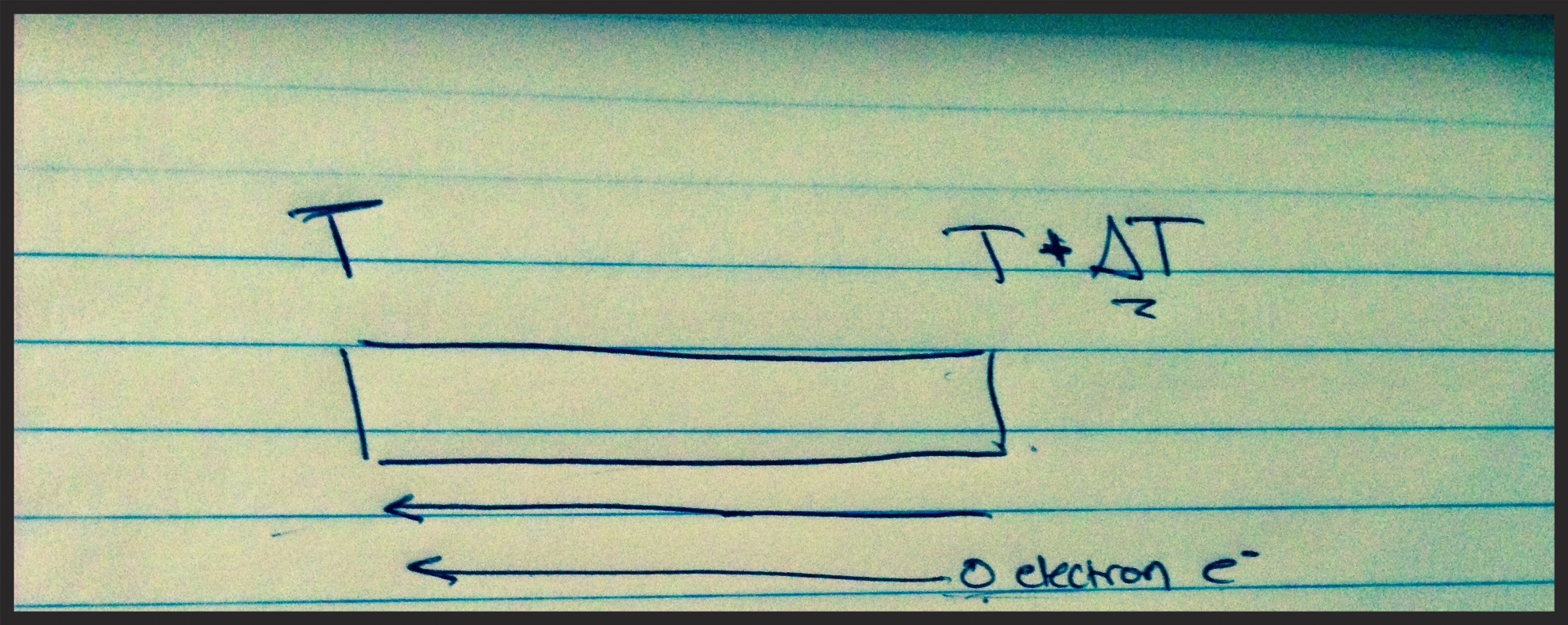
Can I draw it? So basically, there's thermoelectric material. If one side is hotter than the other side, heat moves from hot to cold. That's something we all learned in high-school physics. What moves heat? Electrons and crystals vibrations. When heat moves from hot to cold, the electrons move from hot to cold, and they bring with them electricity. So if you have this temperature gradient, you can create electricity. Understanding how heat flows on the nanoscale allows you to minimize the transfer of heat through the crystal, so therefore all the heat is moved with electrons, and you can more efficiently convert heat directly into electricity.
So, it's a manipulation. There's a lot that can be done.
Tell me about what drew you into this line of work.
I'm Lebanese. I'm Lebanese-American. And when I was younger, I used to go to Lebanon a lot. I don't know if you've been to Africa or Middle-eastern countries -- they have a lot of power shortages. When I was younger I wondered, "why can't everyone have electricity?" America has electricity. Why didn't these guys have electricity? As I've grown up, I've realized it's a lot more complicated than making more energy, but on a very basic level, if you make electricity very cheap, everyone can have electricity.
What was your first creative moment?
If I'm going to go really back, I used to play with K’nex a lot [laughs]. They're great. My dad once got me a set of K’nex when I was five or six. I would make a car, my dad would make a car and we'd just roll them down the hall. Eventually, I figured out that if you give the car three wheels instead of four wheels, it would go faster. I didn't realize it, but there’s actually less inertia that needs to be put into the system [with three wheels]. The fastest pine car derby car is not a four-wheel pine car it’s a three-wheel one. So I made a car that had only three wheels.
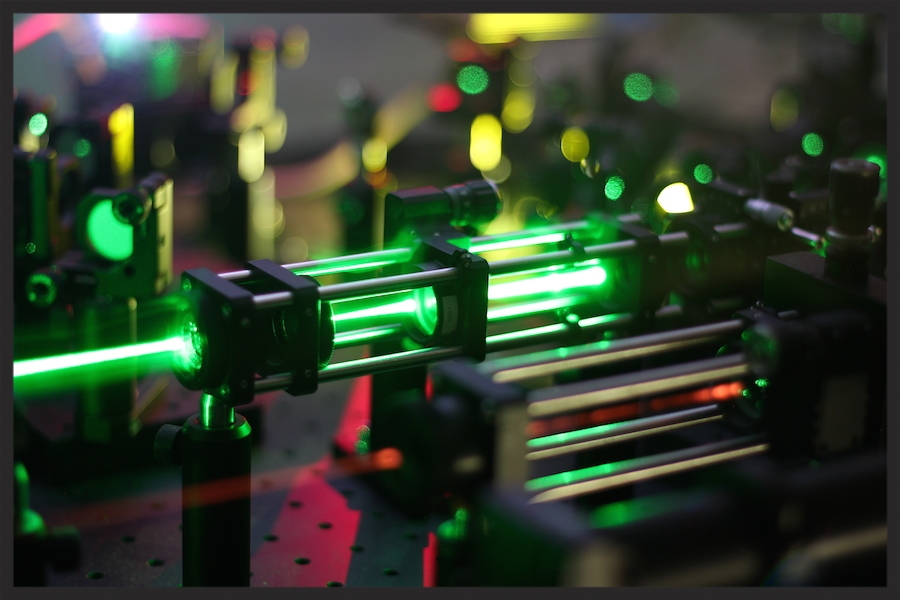
Red and green lasers are used by Elbara's lab to make measurements
Do you do most of your work on your own or as part of a team?
It's a mentoring and being mentored kind of experience. It's a lot of give and take. So I do my work. When I need help I present it to my advisor who helps me and then I assign work to the undergrads that then come to me when they need help.
What's more challenging: being mentored or mentoring?
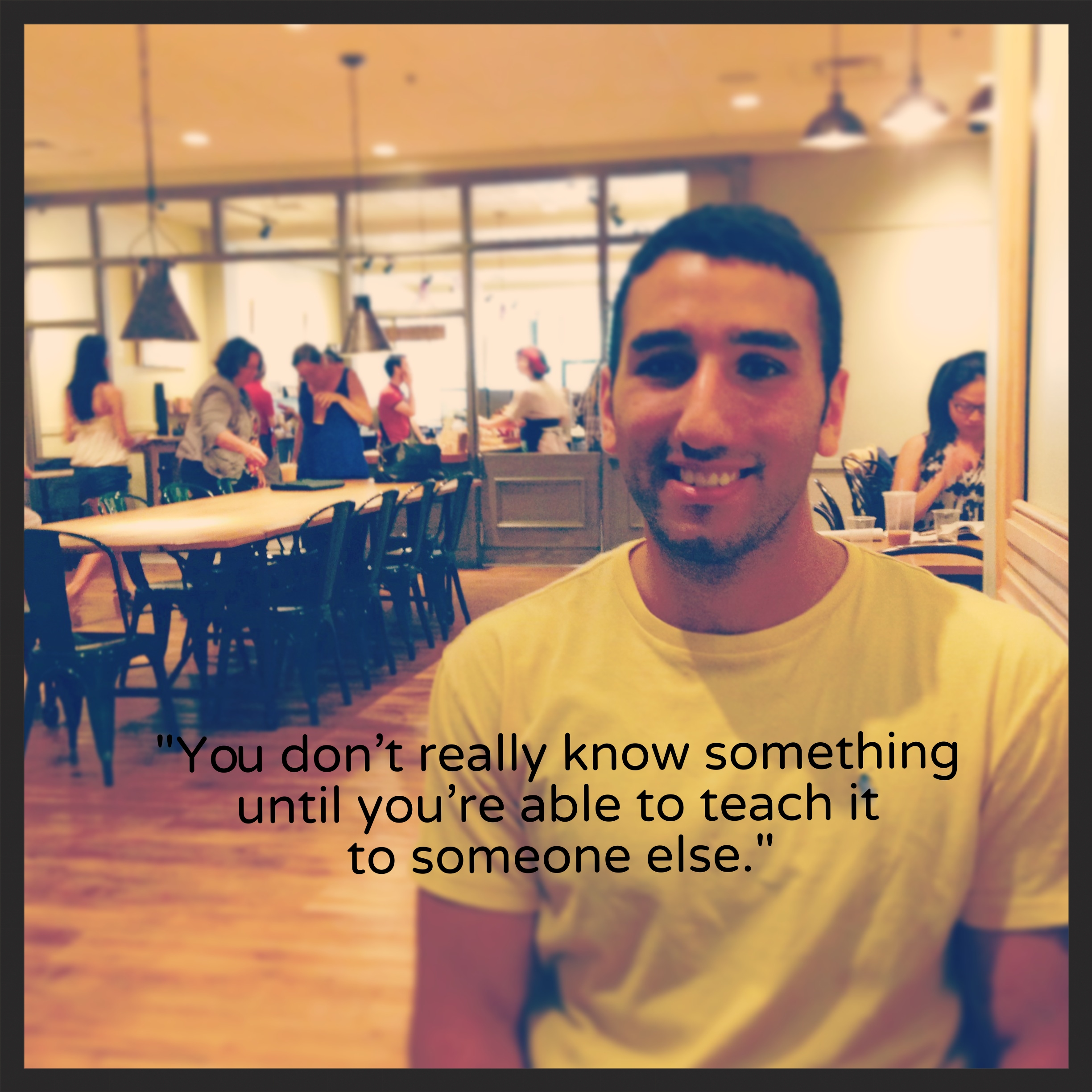
I really enjoy mentoring. You don't really know something until you're able to teach it to someone else. When I can't explain something to somebody, I find that I have to push myself further to understand it. If I can't break down something in very simple terms to someone then on a fundamental level, I don't understand it. In terms of learning and being able to dissect a situation mentoring is more challenging.
What's the best time of day for working?
After lunch is no good. Mostly anytime there's no one really around is a good time for me. In the morning I try to come in early and I have a good one or two hours before anyone else shows up. Late at night usually is pretty good, too. I like to sit down and focus on one thing and just go.
What separates science from art?
Science is an art. There are a lot of beautiful things about science. It has to flow. You know, art flows. Art has a theme. Science usually has a theme, too. My research is very visual. The work I do isn't about graphs and plots, I generate pictures from my work. When I was an undergrad I didn't read as much. In graduate school I realized the importance of reading and writing...and so I think the arts and sciences are more closely related than many people realize.

Science is an art. There are a lot of beautiful things about science.
Do you have any hanging up in your apartment?
No, but I have a few posters in the lab.
Do you listen to music while you work?
If I have to actually think about something, I can't listen to music. It's distracting. I have these noise canceling headphones and when I need to just think, I pause the music and I'll just continue on my way.
What are you working on right now?
There are a few projects I'm working on. One of them, of course, is this thermoelectric project, which has been my main focus for the past year. That's really what kind of drew me into the lab. I also worked with satellites. NASA has a micro-gravity campaign. I'm helping out the Boston University satellite program... That one is more of a hobby. The third project is with a company in Japan that's trying to measure micro-particles.
Why are they interested in that?
This one has a lot of applications. We use a very novel technique that allows you to get a lot of properties out of materials without knowing what they are. They give me this material and they say "get everything." So everything is a mystery.
What do you want to tackle next?
So my dream job is working for JPL out in California...or Tesla [laughs]. JPL does a lot of work on thermoelectrics. The Mars Rover Curiosity? Powered by thermoelectrics. The satellite voyager, which was launched in the 70s and has exited our solar system maybe three or four times, runs off thermoelectrics. The most efficient thermoelectrics actually come out of JPL. Everyone else is just trying.
How fast is this field evolving?
I could probably spend my entire PhD on just one material.
It seems incredibly vast. Is that intimidating to work in a field that's so massive?
Yeah. Yup. Long story short, it can be intimidating. But if you discover something new...
How many people in the world would you say are working in this space?
Specifically in my space? If I were to put a number, I would say no more than 200. Science kind of has a family tree. So there's an advisor that started off a while ago and he had three students, and each of them had a bunch of students underneath, and so they all know each other and then they are advisors for the generation behind them. They all use the same principles, but the physics they use are completely different.
What's the work that you've been most proud of?
After all projects, you look back and realize how far you have come. You have to be positive about what you've done. When you start off, you know absolutely nothing. You hate every second of what you're doing because you know nothing, right? And you are reading and you are working hard. None of the data matches what you expect and the fits aren't good. It's an uphill battle. But then eventually you get to the top, and after a certain point you get the results.
Is the stereotypical eureka moment in science true?
There is this great quote made famous by Isaac Asmiov. There's this misperception that science is like Eureka! But actually, really, what it is is more like a "hmmm, that's funny." If you expected it, then it would already be known, but most of being at the forefront of science is stuff that we don't know. It's usually, "Why isn't this working? Maybe I should look into it," and then you revisit. For most of these projects, there's usually a deliverable, and usually right after the deliverable is where I'm most happy.
If you expected it, then it would already be known, but most of being at the forefront of science is stuff that we don't know. It's usually, 'Why isn't this working? Maybe I should look into it.'
Outside of nanotechnology, what do you do?
I think the last book I read outside of nanotechnology was "on writing well." Most of what I read outside of science is to improve my writing. But I consume a lot of science.
You always have to have something working in your life for you. Right now that for me is running. Normally, when you first start your PhD, you take classes and conduct research - that's it. If your research isn't working, well ok, at least you're doing well in class. But I just finished all my class work. After this fall there are no more classes, so after this fall if my research isn't working well, something else has to work well. You have to have something. So it has been running.
When you're running what do you think about?
Nothing. Blank slate. It's just, "I'm going to finish this, and if I can finish this, I can finish anything."
That's usually how I think about it.