
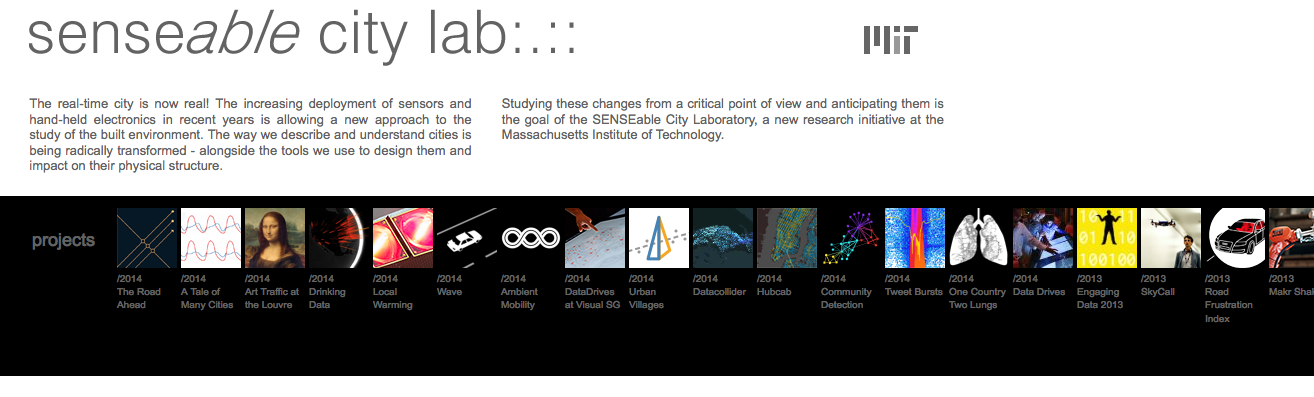
 Miriam Roure is a Research Fellow at MIT’s Senseable City Lab, an institute that studies how digital technologies are changing the way in which cities are studied and understood. Miriam, whose background is in architecture, has been working at the Lab for over a year and has also collaborated with the World Bank and the Area Metropolitana de Barcelona. During her studies at Harvard Graduate School of Design she co-founded Harvard xDesign Conference, which it’s now on it’s third year. I caught up with Miriam at Flour Bakery outside of Kendall Square Cambridge.
How did you get started at the Sensible City Lab?
I was studying at Harvard Graduate School of Design (GSD) and I was very interested in how technology was transforming our lives and our environments. It seemed to me that the most radical transformation that we were going though today was not made out of bricks and stone, but out of Zeros and Ones. Down the street from where I was studying, Sensible City Lab at MIT was looking at exactly this transformation from city science and urban planning perspective.
What is it about tech and design that fascinates you?
Through technology we are able to extend and amplify our capabilities as humans- from the first cutting stone to smartphones. Today, digital technologies are deeply transforming the way in which cities worked and are managed. For the last hundred and fifty years, urban infrastructures have grown to be centralized, exhaustive, standardized and of massive distribution. Nowadays, digital infrastructures could be qualified as the opposite: ubiquitous, de-centralized, flexible, and often invisible. Design, on the other hand, has the capability of working through the unknown, asking questions and bringing problems (and technology) closer to people.
Can you give me an example of that?
We are constantly sending messages, looking for information, making transactions… Our daily lives are filled with data points that, when compiled, can start to reveal patterns and information about ourselves, our daily lives, and about the way we communicate with others that we might not even be aware of. Data then becomes a new currency, one filled with knowledge, which has the capability of creating significant value.
How did you go from thinking about buildings to thinking about data?
After I graduated from my undergraduate studies I went to work at AMO, a think tank within the Office for Metropolitan Architecture. There I worked on projects that required critical analysis of political and socioeconomic conditions - beyond built-form. When looking at the general practice of architecture today, I felt that something was missing - the agency of the architect had been reduced. In the 1960s the role of the architect was very much a social one; it was very much linked to the development of cities, to forming a vision of the future and being active participants of its creation. Today, this agency has been reduced to the creation of objects – architectural ones. I decided to go back to do my Masters to bridge that gap. For me that came into place through this question about how is technology impacting our lives and our urban environments.
"The agency of the architect had been reduced. In the 1960s the role of the architect was very much a social one, it was very much linked to the development of cities. Today, this agency has been reduced to the creation of objects – architectural ones. "
 "The agency of the architect had been reduced. In the 1960s the role of the architect was very much a social one, it was very much linked to the development of cities. Today it has been reduced to the creation of objects to some degree. "
Now that search is becoming more specific: I’m questioning how citizens can be in control of their data. What are the power structures that are behind the data that is being produced. One of the projects I’d like to develop has to do with creating a platform in which people have control over the data they produce and have the ability to act as their own brokers.
Literally to sell it? So profiting off of your own individual data?
So the data market already exists but we’re not being allowed to participate on our own as users. People are becoming more interested in gathering data about their daily habits, their exercise, just for their own improvement, but once you have that data – companies are the ones profiting from it. So if there was a way, as you interact with your digital devices to have a filter in which all of those data points are being collected, then one would be able to make use of that aggregated data for themselves but also as a source of profit.
You wouldn't normally think that would overlap with architecture.
In the field of urban planning cities are coming to use more and more data to optimize their transportation systems. Based on that there’s always a question of who owns that data. There are a number of companies that have extremely valuable data that could be used to improve the common good, so then how do you start creating a more open data platform?
Is it mainly a platform solution or is there some regulation needed there?
When you think about Uber or AirBNB, these companies are unregulated and they’re entering new markets without any regulation. And they’re actually disrupting existing economies and societies that are very much based on a 19th century tax system where the wealth is being redistributed for the common good and then these new platforms come into place and they disrupt that existing system. And it’s great because they often provide very good solutions for the end user. Even though regulating sounds archaic, at the end of the day there’s a tax system that then retrofits society to providing basic cover of education, healthcare, etc that we’ve based our societies on. So we have to be careful when some of these new technologies come into place, what kinds of disruptions they produce.
Whose role is it to figure out how society can keep up with these new technologies?
I think local governments. As users we have to be conscious of it, but the regulations are in the hands of the local government. That said, in terms of data, since it’s such a global phenomenon, we could all benefit from having data agreements at an international level so that we don’t start creating barriers to progress.
Are there projects that you really admire in this space?
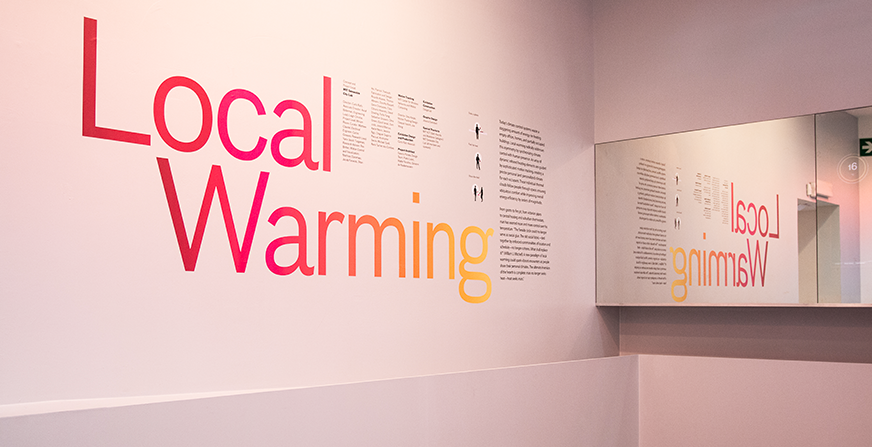
I’m working on a project that’s called Local Warming. It’s about localized heating, so it’s this series of infrared sensors that are able to locate people in a space and project radiation. In more casual terms you can say it creates like a bubble of heat around people and it’s that bubble of heat that follows people through space. The main idea behind the project has to do with efficiency. Instead of heating up full buildings, you’re able to heat up areas where people are. So you don’t have to be wasting a huge amount of energy for people who aren’t there.
What makes you most productive?
I always need space to develop thoughts of my own and structure my thoughts, but then it gets really exciting when it’s people of different disciplines in one room all brainstorming about one project. Crazy ideas from different perspectives come along. There’s no one-way of looking at a project. Different ideas don’t negate each other - they’re complementary.
Is your work more art or science?
I think I’m more of a scientist, but I’m also interested in insights that speak about our human nature. And that’s where art comes into place.
What’s next?
I’m currently collaborating with the Metropolitan Area of Barcelona – they are building a new masterplan for the city. The last one was in 1979 – and this new one should also be able to last 25 years. When thinking of the rapid evolution of digital technologies and their corresponding expiration dates, planning for more than a 5-year timespan becomes a challenge. The masterplan can therefore only approach this issue from a strategic perspective – one that thinks or regulations and physical space in a future where environments and information will be in constant flux – a masterplan of change.
That’s both exciting and a little scary...
It’s scary when our external world starts to have an embedded intelligence and self-learning machines that become entities on themselves. Zeros and Ones are politically agnostic, but when coming together they put power structures in place. For instance, in Singapore there is this road pricing model in which there’s a toll that is updated every couple of days based on the amount of traffic, so that the traffic is always fluid. The result is that only the people who can afford to pay $150 toll can actually go into the city at a certain time. So yes, it’s an intelligent structure in that it creates a really efficient system in terms of traffic, but the downside is the socioeconomic implication – cutting access to transportation for people who might need it the most.
I feel an urgency in being able to assess the implications of these innovations.
I’m at the intersection of industry, academia and government. And innovation is happening everywhere in between. There’s the science side to it and the public good side to it and the market-driven side to it. It’s a matter of finding a balance between these.
I’m at the intersection of industry, academia and local government. And innovation is happening everywhere in between. There’s the science side to it and the public good side to it and the market-driven side to it. It’s a matter of finding a balance between these things.