
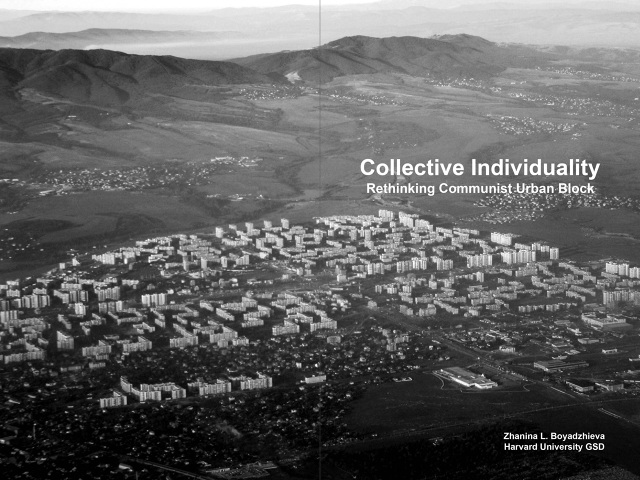
Zhanina Boyadzhieva is a Bulgarian-born architectural designer who now studies and works in Cambridge, Massachusetts. A graduate of Harvard School of Design, she recently self-published Collective Individuality: Reconstructing the Public Realm, a thesis that Zhanina calls, "a year-long fascination" with the comparison of socialist and post-socialist cities with a focus on Eastern Europe. I caught up with Zhanina just as she returned from giving a TedX talk in Sofia, Bulgaria on the topic.
 Is architecture art or science?
My initial definition of architecture has expanded tremendously especially with my thesis project to include politics, culture, social practices and I'm getting more and more interested in this. The link between architecture and urbanism, so cities, and different social practices within them.
You wrote a thesis called Collective Individuality. Tell me about that.
I've lived in the States for eight years now and I've always wanted to do something related to Sofia, my hometown. Four years ago, I attended Sofia Design Week. I attended a 24-hour workshop which had to do with the identity of the city and the first question I had to answer [as part of that workshop] was "What is the color of the city?" And everyone around me said, "Gray."
Everyone said gray?
Right! So then I went around and I thought, "Ok, what is actually gray? Why do people think that?" I thought it has to do with many urban blocks left from socialism and the concrete used in that, but I photographed many of them and realized they are actually colorful; they don't have to do with the [perception of] grayness.
I think back then, this idea of understanding the culture and how someone views a city got stuck in my head. So four years later, I went back to this idea. My thesis had to do with studying the socialist cities and post-socialist cities and understanding urban ideologies in cities and how people see them.
Throughout my research I interviewed the mayor and many directors from the municipality. During one of the conversations I was very struck by one statement. [One of my interview subjects said]: "'Public' has become a dirty word." For me that became a focus of my design, understanding how you can change this perception of "the public" in a post-socialist city.
How does form influence experience?
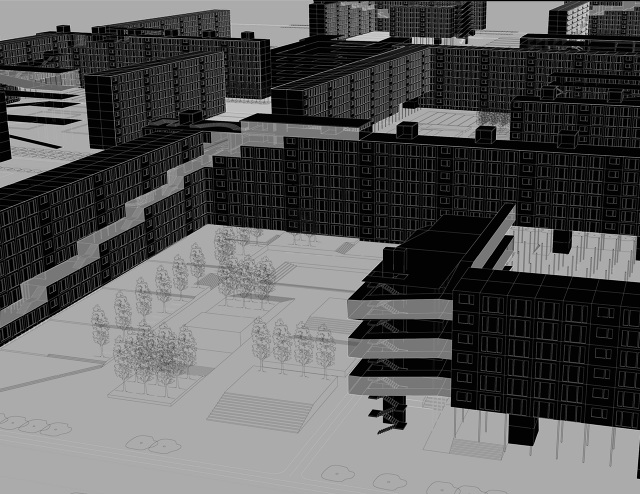
In the case of the communist urban blocks, it's an interesting thing. They were thought of as these micro regions. Mikrorayon is the terminology in architecture. They were thought of as these very networked regions and self-sustaining neighborhoods, which were supposed to have residential blocks but also a lot of public and collective spaces, like kitchens and laundromats, sports facilities, and other shared communal spaces. But these were never really built [in Bulgaria] because of lack of resources and hardly anyone knows that they were supposed to have all these amenities for the people. They are left with all of these bare, concrete blocks and undefined spaces in between them so strictly talking about this context, I came up with a strategy of creating a new public ground.
You defined different kinds of spaces in your research, what does each mean?
Horizontal has to do with the spaces between the blocks. There are these massive areas which are left over, they are undefined. Can you introduce areas of parks, markets or open air cinemas, just activities for different users to gather?
Then, I looked into the blocks themselves and the way they are built is just by stacking the same apartment into these massive blocks. There is no connection between the different apartments. The only shared space is the circulation core, the staircase. I imagined the insertion of these public spaces that covers the whole block and reaches the roof for young and old users alike, like daycare facilities and wifi cafes or yoga studios.
Then, vertical is integrating private spaces like businesses or malls, but juxtaposing them. Public and private spaces should be all together so you never have this binary, and its more fluid and active.
Outside of architecture, what are some of the things that inspire you?
I'm very interested in human interaction, different social practices, so I guess a lot of sociology.
When you were growing up, what was the first creative thing that really struck you?
I like this idea of public participation or gathering with other people and thinking about the space outside your apartment as your own. When I was little my parents and a few neighbors would gather every spring and clean a little garden outside of our apartment. It is tricky when you think about socialist and post-socialist cities because you don't really know who owns that space and a lot of people are afraid to touch it. But we did.
So that's embedded in my thinking about how you interact with other people and create collaborative spaces.
 When I was little my parents and a few neighbors would gather every spring and clean a little garden outside of our apartment. It's tricky when you think about socialist and post-socialist cities because you don't really know who owns that space, and a lot of people are afraid to touch it. But we did.
Is there a time of the day that you're more creative?
Mornings. If I wake up early I think, "Ok, I have a long day ahead of me, and I can do many different things." I think I'm just calmer about it all.
Do you have a routine with the music you listen to?
It varies. I listen to a lot of Bonobo -- something that is more mellow. But I noticed during finals when you study 24/7, you have to play something very upbeat.
Do you work differently than your peers?
Everyone is different, to be honest. Every designer has a different approach. I've been privileged to be in such a diverse environment because you learn from everyone.
Who pushes you?
Friends push me. I have been lucky with the people I've been surrounded with. My friends are a bunch of humanitarians I suppose, social activists who do creative design things or write books. I actually just got a book of short stories that was written by very close friend of mine. Then, I have friends in the business or more corporate world and my boyfriend is the opposite, he's a scientist, he's a mechanical engineer. I think that diverse mix keeps you going.
Do you think having a diverse mix of friends adds to your creativity?
I think it adds to being open to different perspectives and being able to look at a problem from different points of view.
Is there something you want to tackle next?
I want to have experience in building something. For years I've been in academia so it's been a lot of theory, a lot of history, a lot of conceptual design. I do want to learn how to make something actually real.
When you start a thesis you never know what your subject is, you kind of jump into it with a vague idea and then it really shifts throughout the whole thing. It's very vague, it's very blurry, you don't know what's happening. It's very stressful. But the more you gather, the deeper you go into whatever the subject is, you discover new things and you shift and adapt.
 How did your story shift?
I never thought that I'd be focusing on the public or the public ground. I just had the intuition that there's a problem in these systems and then I wanted to think about the problem in terms of socialists/post-socialists. I wanted to think about the blocks. But I had no idea how... and it ended up being the spaces between the blocks rather than the blocks themselves.
What's something people get wrong about architecture?
The link between architecture and cities and social practices. I think a lot of people look at a building and think, "Ok, this is one building. These are the details of the building." They don't necessarily try to grasp the effect of the building and the surrounding context or understand the culture of the space. It's all part of a much larger network of things.
Are there other cities that have been shaped by an ideology?
Oh, ...all of them. Berlin is very interesting to me. Berlin is one that has always struggled with its history and shifting between a memory of something in the past that you reject and progressive thinking of something in the future. Detroit is another one.
I think a lot of people look at a building and think, "Ok, this is one building. These are the details of the building." They don't necessarily try to grasp the effect of the building and the surrounding context or understand the culture of the space.
Summarize for me the architectural shift from a socialist to post-socialist city.
Socialist cities in general have a long history with modernism, but it was very infused with social values. So you know you have the Communist manifesto, Karl Marx, and the basic idea is everyone has the same rights. Same houses, same spaces. It got into so much detail that people would even think about the same travel time to work, for example.
So the socialist city starts to resemble a machine. It is very structured, very organized. It's all about this idea of networked spaces - that's a good thing about it. Of course, it has a lot of drawbacks, too, like this sameness or repetition in which the individual gets lost. It's like a jungle of the same thing. So even though it had this dream of a very public and functional city for the people, it often became an image of this rather than actually functioning as such.
Then the post-socialist city was really a moment of a lot of chaos and confusion. People didn't really know what the city should look like, what the identity should be, because it was so structured in the previous regime. So a lot of informal build-up happened, a lot of construction of illegal buildings. Later, in the 90s and 2000, when there was more money coming in from the European Union, a lot of private corporations, offices, and malls came. Gated communities became a phenomenon of the post-socialist city.
It had to do with this idea of "public as a dirty word." People wanted to escape from a memory of the past - a city that used to be for the public, supposedly. So you have all of these gated communities, you have all these private structures, and everything becomes closed off and behind walls. It's all about the individual... but it reaches such an extreme that you forget about the common good.
So that's the separate criticism of these two cities.